Announcement of ISV Hierarchical Management in SEA Market

Danh mục dịch vụ đối tác
  1. Background

As TTS expands its business coverage and adds new business in Southeast Asia, independent software vendors (ISVs), as an important support for the technology ecosystem, need to quickly respond to the implementation requirements of new business in Southeast Asia, while meeting the growth of GMV and profit, and providing complex requirements such as multilingual, multi-regional compliance, localization adaptation, and parallel support for multiple development tasks. Therefore, a hierarchy ISV management system needs to be established.
  1. ISV Level

Divide ISV into three levels
ISV Level Meaning Ability Number of ISV
Class S
  • Top ISV
  • Actively connect to TikTok Shop API
  • Connected to many sellers
High average daily API calls
15
Class A Good ISV
  • docked a certain number of sellers
  • The average number of API calls per day is a certain amount
About 100
Class B General ISV
  • Have the ability to correctly publish and use APP
  • There are docking sellers
  • Call API daily
Other
  1. ISV Hierarchical Management Strategy

3.1 ISV Score Calculation

The ISV is scored according to the number of ISV service sellers and the average number of API calls per day, and ranked from high to low to obtain the above screening results.
Example of calculation formula: Suppose
  1. The number of sellers using a certain ISV A service is the largest, reaching 1,000,000
  2. ISV B has the highest average daily API calls, at 10,000
  3. Now, to calculate the score of ISV C (assuming that the number of sellers served by C is 800,000 and the average number of API calls per day is 1,800), the calculation formula is
800,000/1,000,000*50%+1,800/10,000*50%=0.49
  1. If one ISV's daily API calls is zero, then we consider all its sellers are not active, we would set its score to zero.

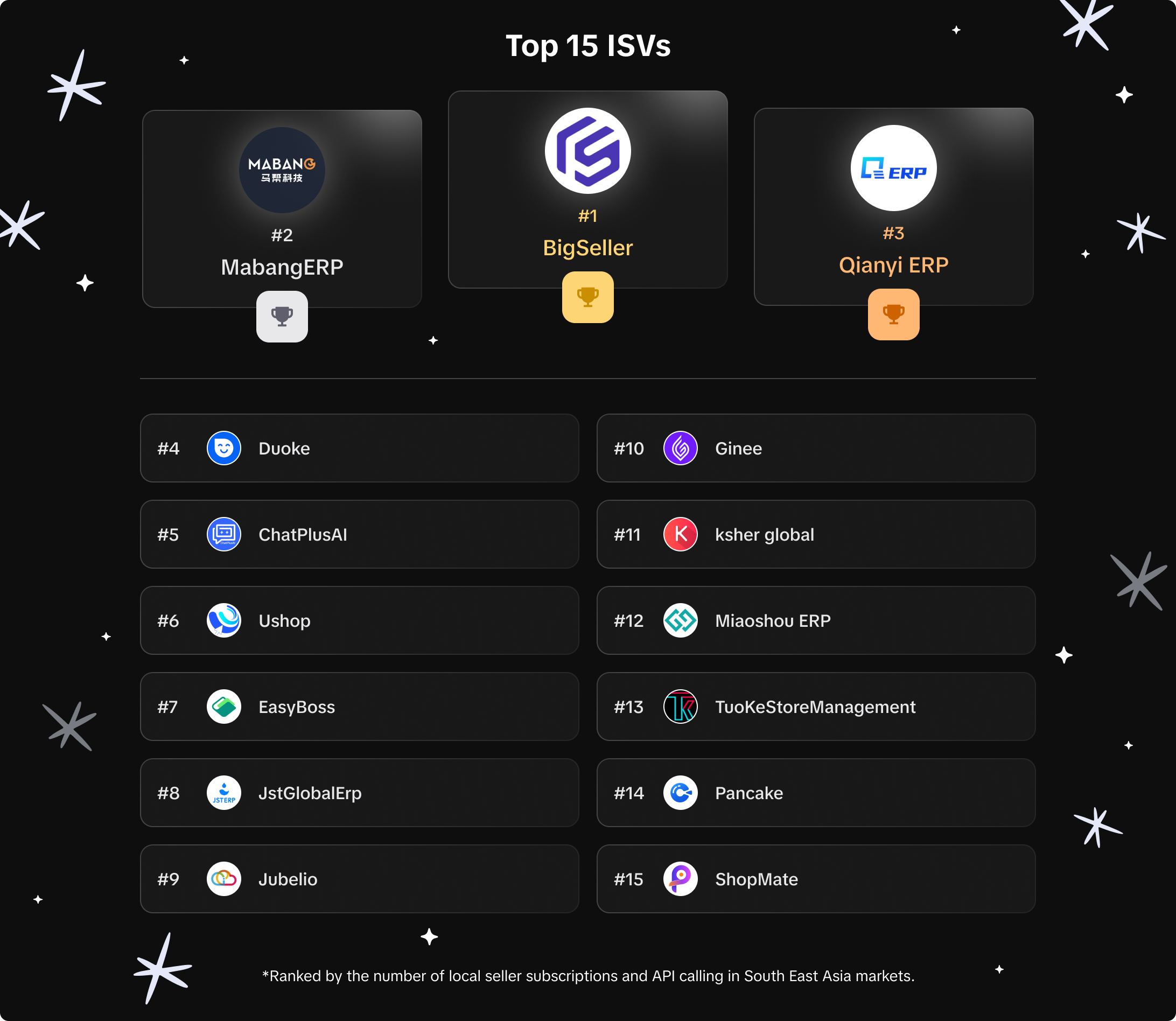
3.2 Class S ISV list

Here is class S ISV (top ISV) list ranked by the number of local seller subscriptions and API calling in SEA:
image

3.3 ISV Rights and Obligations

3.3.1 Specific definitions of rights and obligations
ISV LevelRightObligation
Class S
  • Platform exclusive capabilities
    • Priority participation in new projects and early access to testing
    • Specific API interfaces are open, and you can participate in the API to give priority to using and integrating the platform's open capabilities
    • Improvement of specific API call QPS(under the limitation of TTS platform ability)
    • Applications for Public APP will be prioritized for approval after communication
  • Platform Endorsement
    • When promoting new projects, ISV can be exposed, users can be recommended to experience new functions on ISV, and ISV can participate in the user publicity and training of the platform
    • The platform participates in ISV's external publicity activities and gives a speech (the platform needs to be approved internally)
  • Tagging Recommendation
    • Badge tagging in App Store (Top ISV label can be tagged)
  • Actively participate in the platform's key projects and grow together with the platform
  • Continuously innovate and improve product capabilities
  • Comply with ISV-related operation and technical specifications
  • Product function bugs are repaired in time according to the level
Can cooperate with the platform to adapt, transform and upgrade the interface/function within the time specified by the platform
Class A
  • Applications for Public APP will be prioritized for approval after communication
Badge tagging in App Store (Good ISV label can be tagged)
  • Participate in platform cooperation projects
  • Comply with relevant operation and technical specifications
  • Product function bugs are repaired in time according to the level
  • Can cooperate with the platform to adapt, transform and upgrade the interface/function within the time specified by the platform
Class B
  • Comply with ISV-related operation and technical specifications
3.3.2 Tagging
Resource Name
Resource Location Introduction
Display position
Badge
Badges can be used to label ISVs, highlight their advantages, and attract more attention from sellers
  • Service Market Independent Website
  • Seller Center Service Market

3.4 Communication mechanism

ISV LevelCommunication mechanism
Class S
  • The platform conducts regular visits or exchanges
  • Focus on responding to their needs, feedback and suggestions
  • Each ISV sets up an independent Feishu group to maintain close communication and exchange
  • Select excellent ISVs at the end of the year and present physical trophies
Class A
  • The platform will follow up and handle the docking problems
  • Select excellent ISVs at the end of the year and present physical trophies
Class B
  • The platform's daily updates and information announcements will be notified on the Partner website, email and Feishu group
  • Ensure that the generation and use of the APP comply with the specifications through the APP approval portal
  • The sellers choose whether to use the APP, and the effectiveness of the APP is judged by collecting the feedback from the sellers
  1. Periodic review

4.1 Quarterly evaluation mechanism

The evaluation dimensions include :
  1. Growth of the number of sellers
  2. API call growth and decline
  3. Whether participated in key projects and whether actively participated in key projects
  4. Whether new product capabilities have been provided and released to the service market
  5. Is there any growth in the corresponding service subscriptions in the service market
  6. Whether to comply with the relevant operation and technical specifications of ISV
  7. Whether the customer complaint service has responded within the specified response time, and whether the customer is satisfied with the service (customer research will be conducted)
  8. Whether the product function bugs are repaired in time according to the level
  9. Whether to cooperate with the platform to adapt, transform or upgrade the interface/function within the time limit set by the platform
  10. Whether to participate in specific activities
Different levels of ISV correspond to the above different dimensional items respectively, and scores are given accordingly.

4.2 Annual evaluation review

Based on the annual implementation of the rights and obligations of the corresponding level of ISV and the quarterly score, the final annual evaluation is determined to select the excellent ISV. The excellent ISV will be selected at the end of the year and awarded a physical trophy, or the ISV will be upgraded, downgraded or cleared. See the next chapter for specific rules.
  1. ISV level dynamic adjustment

Adjustment rules:
ISV LevelLevel adjustment rules
Class S
  • There is no promotion or relegation mechanism for the time being
  • Evaluate every six months to determine whether the performance and contribution to the platform are qualified, so as to determine whether to continue the invitation in the next year
Class A
  • For key performance, such as the new API interface not being updated for half a year, consider downgrading.
  • For ISVs with excellent performance, such as those that have reached the S - level ISV standard, they may be considered as S - level ISVs by invitation in the following year
Class B
  • The evaluation will be carried out every six months. If there are major violations, such as serious data leakage or serious complaints from sellers, the seller will be removed according to the regulations of TikTok Shop.
  • For ISVs with excellent performance, such as those that have already met the standards of Class A ISVs, they may be considered for promotion to Class A in the following year.